
. .     Home   •   About the Site   •   About the Museum   •   Visit www.penobscotmarinemuseum.org .  .

 .  .  .  .
.
.
Penobscot Marine Museum
Learn AboutSpecial Features

Search Our Collection
 .     
 .
right frame  
.
.
 .
image  .

Marine Art:

Ship Portraits in Art History


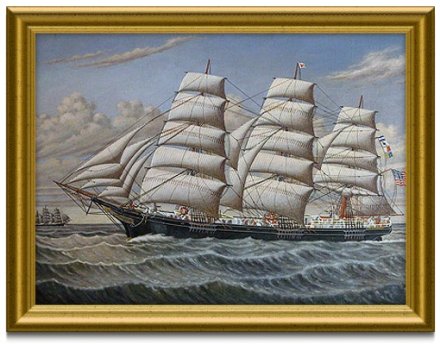
Perhaps the most significant aspect of marine art is that it was client-driven.  [Ship portraits] in particular were not done for art’s sake or for collectors of fine art, but rather for buyers with a personal interest in the subject. Today we value both signed and unsigned examples for their unique history and their attractiveness.  For people interested in maritime history, these works are sourcdes about the past, as well as works of art.

Marine art reflects early European influences. In the 16th century, ex voto paintings were often commissioned by religious seafarers who were thankful after surviving maritime disasters. As artists moved away from religious and heroic paintings in the seventeenth century, towards painting the world around them, marine art flourished in the Netherlands. Hendrick Vroom (1566-1640), an important early Dutch marine artist, created commemorative paintings of Dutch and English naval battles and vessels. He influenced other artists in Holland, including the Van de Veldes, father and son, who emigrated to England in 1672 and influenced a growing school of marine art in Britain.

Both Holland and England were sea powers, linked to the oceans of the world for their wealth, power, and food supplies. Their identities were tied to the sea. Seascapes reflected their maritime interests.

These paintings of the Greenland whale fishery by Joghem de Vries, done in 1769, show a highly developed Dutch marine art tradition.

In the 17th and 18th centuries, the Dutch had a major whale fishery, and Dutch marine artists painted it. These paintings may have been designed for a house or hall. They are in pairs and could fit around tall narrow windows. The setting presents a complete view of the Greenland whale fishery, one that the artist must have seen.

One of the museum’s founders purchased these paintings from the Hearst Collection in California. After his family left Searsport, they were in the whaling business and collected whaling art.

frame
  photo  
frame Dutch Whaling: Groenlandia spacer
 .  .  .  .  .

frame
  photo  
frame Dutch Whaling: Vreeden Hof spacer
 .  .  .  .  .
frame
  photo  
frame Dutch Whaling: Europa spacer
 .  .  .  .  .
 
frame
  photo  
frame Dutch Whaling: De VreesDutch Whaling: De Vrees spacer
 .  .  .  .  .


Other markets influenced sea paintings, such as printed books that could be illustrated with woodcuts and engravings. Seventeenth century maps and charts were often well illustrated with ships and seafaring scenes.  A growing market for realistic portraits and landscapes extended to the marine world. Less trained artists, who painted on banners, carriages, murals, wallpaper, and objects; and seamen themselves, tried their hands at ship portraits. Naval officers in training were taught to use precise penmanship while learning about navigation, keeping logs, and dead reckoning. Many of their practice books featured drawings of ships, shorelines, the compass rose, and other nautical motifs. An artistically talented seafarer might progress to ship portraiture.

frame
  photo  
frame Ship Clarissa B. Carver spacer
 .  .  .  .  .
Marine Art Around the World

By the latter part of the 19th century, marine artists or pierhead painters could be found in Europe, the Mediterranean, China, and the Northeast United States. Penobscot Marine Museum has examples of ship portraits done in cities around the world.

The Clarissa B. Carver, built in Searsport in 1876, was painted by an unknown artist in China. It shows the ship off Lintin Island at the mouth of the Pearl River, near Macao.

The ship Nancy Pendleton (below) was painted in Bremerhaven, Germany, by Carl Fedeler (1799-1858). The Bark Elberta (below) of Prospect, Maine, was painted in Marseilles, France, by Joseph Honoré Maxime Pellegrin (1793-1869).

frame
  photo  
frame Ship Nancy Pendleton spacer
 .  .  .  .  .
frame
  photo  
frame Bark Elberta spacer
 .  .  .  .  .


Marie Edouard Adam (1847-1929) of Le Havre, France, is a well-regarded marine artist.  He painted the ship Oneida in 1877. The Oneida was built in Searsport at the McGilvery Yard, by master builder Marlboro Packard. She was built for Captain McGilvery and some partners, who sold her in 1888 for the Alaskan salmon cannery trade.

frame
  photo  
frame Ship Oneida spacer
 .  .  .  .  .

frame
  photo  
frame Mary Jenness spacer
 .  .  .  .  .

Italian painter Luigi Renault (active 1858-1880) painted the Mary Jenness entering Livorno (Leghorn), Italy in 1876.

Captain George Harrison Oakes took the Mary Jenness on her first voyage down to New York, and there loaded and sailed her to Livorno. He was proud of the new ship, the 505 ton, 132’ product of his father Joseph’s yard in Brewer. He hired Renault to paint her. Renault was a good choice for he would be appointed marine artist to the King of Italy.

The museum library has the journal kept by thirteen-year-old Margaret Oakes who sailed with her father on the second voyage of the Jenness in 1880.


 . lifebuoys

  User's Guide
Types of Marine Art

Ship Portraits in Art History

Liverpool Painters

Marine Artists in America

Stories Told by Marine Paintings

Prominent Maine Marine Painters

The Buttersworths

Non-paint Media

 
 .
For Educators
 .
Resources
 .  .  .  .

hr

Related Links and Downloads:


 .  .  .
 .
.
 .  .  .  .  .  .

.   © Penobscot Marine Museum     Home   •   Contact   •   Credits   •   Sitemap .
