
 |

 |
 |

Maine and the Orient:
The Colcord Family of Searsport |
Joanna and Lincoln Colcord were born at sea, aboard the Charlotte A. Littlefield, in 1881 and 1883 respectively. Their parents were Captain Lincoln A. Colcord and Jane French Sweetser Colcord of Searsport. Over the next 20 years the family took many voyages together. Sometimes Captain Colcord sailed alone, but more often he was accompanied by his wife and one or both of his children. Joanna and Lincoln did lessons on board, and Joanna even took her final exams from Searsport High School in Hong Kong. She had to wait several months to learn whether or not she had passed.
A typical voyage might be one taken in 1895-97 by the whole family, aboard the bark Harvard. Joanna was 14, and Lincoln 12. Leaving from New York, they sailed first to Port Elizabeth, near the Cape of Good Hope in South Africa. From there they went on to Durban, on the east coast of Africa; Newcastle in New South Wales, Australia; across the Pacific to Mollendo, on the west coast of South America; north to Astoria and then Portland, in Oregon; south to Santa Rosalia on the west coast of Mexico; then back to Victoria, British Columbia; and ending up in Tacoma, Washington.
From there, Mrs. Colcord, who had been very ill during the voyage, traveled home with the children on the Canadian Pacific Railway. Captain Colcord took the Harvard on to Iquique and Junin, on the west coast of South America; then to Philadelphia; and finally back to New York.
The vessel carried cargoes of timber and nitrates, but sometimes sailed in ballast from port to port.
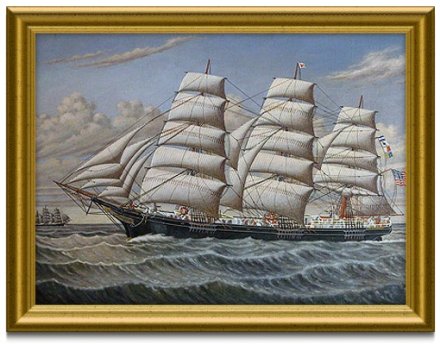
Between 1899 and 1901 Captain and Mrs. Colcord and Joanna made several voyages to the Orient on the State of Maine. Son Lincoln remained at home to attend Searsport High School and later the University of Maine at Orono.
|
The State of Maine carried case oil from New York and brought back tea, fans, and rattan furniture. In Letters from Sea, Joanna describes these cargoes as desirably “light and clean.” On the second voyage, 1900-01, Joanna took a camera along, and her photographs preserved a record of the voyage.
This was a time when steamers were taking over the bulk cargo trades, and sea routes were made shorter by first the Suez Canal and then the Panama Canal. The days of sail were coming to a close.
|
|
 |

|
Related Links and Downloads:
|
|
 |
 |
 |
|
 |
