
 |

 |
 |

Life at Sea:
The Crew |
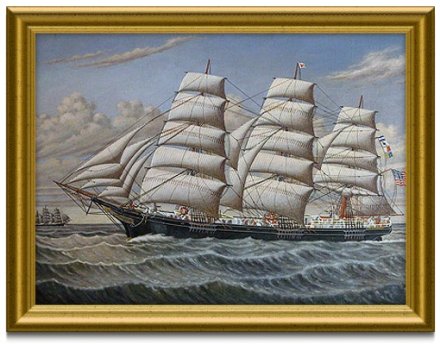
Crew size depended on the size and rig of the ship. A two-masted schooner might have a crew of five, while a clipper ship might carry eighty to a hundred men. A four-masted schooner at the end of the nineteenth century had a crew of about eleven; a Down Easter had a crew of twenty to thirty.
Officers
The first mate, or chief mate, supervised day-to-day ship operations. At sea, he was in charge of one watch, had general charge of the ship if the captain was below, kept the logbook, and took navigational sights with the captain. In port, he supervised loading and unloading, while the captain took care of the business of the ship. If something happened to the captain, the first mate took over.
The second mate was in charge of half of the crew. He was typically promoted from among the able-bodied seamen. As an experienced hand, he led the rest of the seamen in the work of running the ship, especially furling sails and working in the rigging.
As an officer, he oversaw the seamen who steered the ship on his watch. The second mate also managed food supplies and checked on the condition of stored food.
Both mates were addressed as “Mister” or “Sir.”
Skilled Trades
A cook was indispensable—popular if good, not so if bad! The cook baked bread and made meals for the captain’s cabin and for the crew. He had a long day of work, so did not stand watches. On fishing schooners, the cook was sometimes second in importance only to the captain.
On larger ships, the cook reported to the steward, who was the captain’s servant and kept the captain’s cabin clean. If the captain’s wife was aboard, there might be a stewardess, possibly the steward’s wife. In the deep sea trades, many stewards were from China or another Far Eastern country.
|
Seamen
Seamen operated and maintained the ship. Those signing on for the first or second time were ordinary seamen, and those with more experience were able-bodied seamen. Maine’s maritime communities often supplied crew for schooners carrying Maine cargoes to other East Coast ports.
|
|
|
Bigger ships, sailing from cities such as New York, had crews from all over the world, including northern Europe, the West Indies, and China. By the late nineteenth century, it was sometimes difficult to find a good crew. Life at sea was hard, and often there were easier and better-paying jobs available ashore.
On larger ships, the boatswain (pronounced bos’n) was in charge of maintenance. Under direct supervision by the first mate, the boatswain kept an eye on the condition of the hull and the rigging. He led work such as painting; repairing, replacing, or splicing lines; making sure shackles were in good shape; and maintaining mechanical equipment such as the capstan. He also kept track of maintenance supplies in the [bos’n’s locker].
Some larger square-rigged vessels carried a carpenter who was in charge of maintaining all wooden structures, including the ship’s boats. Some also had a sailmaker. Sails often required repairs, and sometimes the crew, under the sailmaker's direction, made new sails from canvas carried aboard. A square-rigger usually had two “suits” of sails: an older one used in light winds and a newer one used for heavy weather sailing.
|
|
Carpenters and sailmakers were considered idlers, as they did not stand regular watches, and they lived aft with the mates, steward, and boys.
At the age of sixteen, a young man could sign on as a boy. Like midshipmen in the Navy, boys had some advantages and often were friends of the captain or the owners. They learned the basics of operating the ship and navigation. Some boys went on to become captains; some never went to sea again. Edwin Mitchell, a 16 year old from Belfast, took one voyage to California and back in 1866-67, then never went to sea again. He went on to make his living selling eggs. Read his journal in the Special Features section of this web site.
|
|
|
 |

|
Related Links and Downloads:
|
|
 |
 |
 |
|
 |
